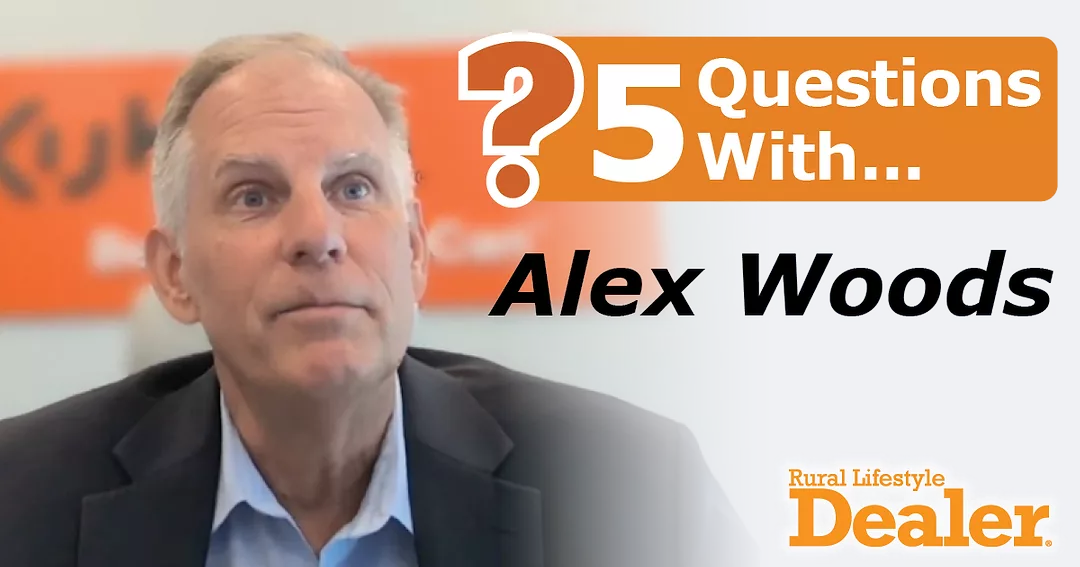
During a deep dive discussion with Kubota Tractor Corporation’s Alex Woods, he shared his thoughts on what’s driving buying decisions in the rural lifestyle market, technology advancements, innovations and more.
Woods started his career at Kubota 25 years ago and on July 1, 2025, was named president of Kubota Tractor Corp. He also holds the role of manager of supply chain for North America.
What’s your outlook for the rest of 2025, and are you anticipating any relief coming by year's end?
Woods: Coming off of the post COVID years, what we continue to say is that we're going to find a new plateau, to stabilize and then to start to build from there. It's just taken us quite a bit longer to find this new plateau than we originally anticipated. We're clearly well into 2025 and the first 5 months were quite a bit like the last 6 in 2024. There’s still a lot of instability out there, a lot of questions and, every time you get to feeling like maybe we were ready to turn the corner, something else would happen.
With that said, and maybe a little bit surprised, June and July have been a little bit more positive in the market. We've seen a bit of an uptick. Maybe our customers are just stabilizing to an unstable market, but we're a little bit more optimistic here realizing the last 2 months don’t necessarily make a trend. There's a lot of talk in the market right now that we might see something in interest rates as early as September. Also, we certainly understand the changes in the new bills which are going to have some effect on year-end buying and depreciation tax credits and so forth.
There are some positive things in the market, certainly nothing that's giving us cause to change our current business plan for the short term; but there are some things that I think we should watch closely and be prepared to pivot if things start to improve a little bit.
What key factors do you currently see driving buying habits in the market? What are you hearing from your dealers?
Woods: At the end of the day, customers are seeking and making their buying decisions based upon value. There are a number of different factors involved in that, and I think they definitely are looking at reliability and versatility on the products that they're buying. They're also looking closely, more so than ever, in the support they're going to get from a local dealer from a parts and service standpoint. They're looking at the long-term retention value of what they're purchasing, resale value and so forth — ease of use, ergonomics, comfort features, availability of equipment, those are becoming more important. A couple of years ago, equipment availability was a big driver, so we definitely see — especially customers in this market segment, they'd like to walk in and touch that tractor and take it home with them. Availability is going to continue to be an issue.
You combine all those together and, obviously, price is the other part of that factor and then, largely, the cost of ownership per month. You roll all those things together and that's the value proposition. Each one of those is a little different for each customer. The opportunity is to make sure you listen to the customer, understand what their value proposition is and, from that, you can approach it in the right direction.
What do you think has been the most innovative equipment advancement in the last decade?
Woods: There's certainly been quite a bit going on in this industry. We're definitely seeing it in the way of smart technologies, GPSs and telematics and precision controlling. Also, emissions technology which has actually produced in my view some better fuel efficiencies and so forth in our machines, made them more cost-effective. But, particularly when we're talking about the rural lifestyle customer — a lot of those technologies tend to appeal to more commercial and higher level customers — we're starting to see that technology start to permeate down into these customer segments. That continues to also include safety, a lot of additional things we can put into safety features and ergonomics that are making comfort and productivity more important.
All those together, as they start to move down into the product classes, are going to start to be more apparent and are certainly significant. But if I could go back a little further than 10 years, as we talk about the rural lifestyle customer, the introduction of the subcompact tractor back almost 25 years ago — which was actually done by Kubota, we were the ones that created that market — I think that has had the most impact on these customers. If you look at the sale of tractors in the industry under 20 horsepower, that makes up almost 40% of the entire tractor market now. It's a significant portion of the business and I think we take pride in the fact that we helped bring it to board.
What are you seeing as far as innovations over the next decade?
Woods: While this has slowed down a little bit in the last couple years, I think we're going to continue to see something develop with electrification and other fuel sources, power sources are going to continue to develop. As that technology develops and the pricing comes a little bit more in line, there's going to be a certain portion of lifestyle users that that's going to appeal to so that's going to be part of it. We hear a lot in the industry around automation and autonomous and semi-autonomous automation and connectivity, and how that's going to affect us with integrated telematics and so forth. The opportunity is how we use those technologies to appeal to customers in this segment.
A rural lifestyle customer wants to sit in his tractor or her tractor and use it. So, is autonomy really going to be a driver in this segment? No, but two areas that I really see, these folks, they have other jobs and I think a lot of them spend all week thinking about what they're going to do that weekend with their equipment and on their farm. First of all, that machine's got to be ready to go to work Saturday morning. The ability to provide remote service and use telematics and preventative maintenance options and so forth — to make sure that we can do that work before the machine goes down, and so it is ready to go Saturday morning — is going to be a great opportunity for us, and these technologies will help drive that. Also, a lot of our owners are probably less experienced in equipment operation. While they may be able to do an OK job, as we start to look at these features and automations and precision features being added to the equipment, I think the opportunity is they will be able to do work at a professional grade level. Those are some opportunities of using technology but applying it to the customer, to needs that I think are going to be real opportunities going forward.
When it comes to how dealers help those customers rise to that level of technology and make sure that their needs are met, there is opportunity there as well. The opportunity is for us to make sure those dealers are well-trained on the technology and it is developing. And I think, together, we see the real opportunity in how to present it in such a way that it ... As I talked earlier, about the value proposition. How does it improve the experience and does it add value to the customer? If we approach it properly and if we listen to the customer and we approach it from how they use this equipment, there's a lot of opportunity there.
What advice would you give to your younger self?
Woods: It's important to always be curious, always willing to learn new things and, obviously, don't be afraid to ask questions, don't be afraid, when you don't know something, to say it. I think keeping an open mind and embracing change are important, because things are evolving very quickly. Talk less, listen more.
I've spent my entire career in this industry working for OEMs, graduated from college and was handed a set of car keys and a stack of manuals and said ‘Start calling on dealers.’ The OEM made it clear to me of what was expected of me and what I should expect of a dealer representing the OEM. But if I could have a do-over or go back and tell myself something, what I would've done is, No. 1: someone should have told me a dealer is an independent business owner. They can do business with whomever they care to do business with. It's your opportunity as an OEM to make sure you're the most obvious, easiest to do business one out there, and so keep that in mind to begin with.
One thing that I share with new salespeople that come on board at Kubota that I wish I’d have done better is, the first time I walked in to see a dealer, to ask them what they expected of me. I would go in always trying to say what we expect of them, but I think I would've gotten more done faster if I had sat down first and asked, ‘As a dealer, what do you expect of me? How often do you want to see me? How soon in advance do you want me to schedule appointments? Who in this dealership do you want me to talk to? Who in the dealership do you absolutely not want me to talk to?’ If I would've taken a little different tack there, I think maybe I would've got more done faster. So that is some of the advice I’d offer my younger self.