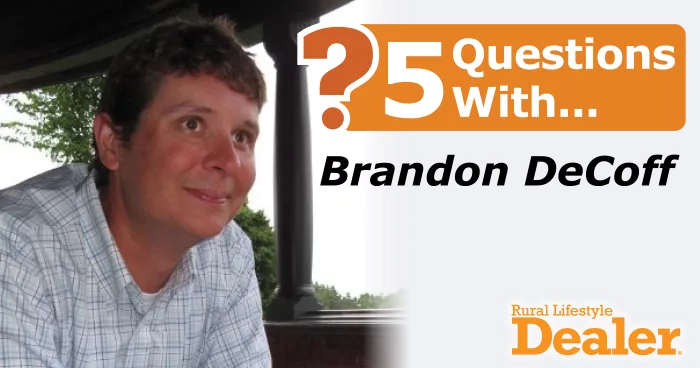
In this installment of “5 Questions with …,” Brandon DeCoff, vice president of sales and marketing at Generac Chore, delves into what sets Mean Green apart from the herd. He discusses major trends in the the OPE market, top priorities, challenges rural lifestyle dealers are facing and the outlook for the year ahead.
What should equipment dealers know about Mean Green in terms of what sets it apart and what’s new?
DeCoff: What sets us apart is that we invented the category, we approached it from a different design standpoint and, more importantly, we have over a decade of real-world proven results. You can take my word for it or not. Talk to a commercial operator that’s been sitting on a Mean Green mower for the last 2 years, 5 years, 10 years and what they will tell you is that their experience has validated what Joe Conrad and his son Matt set out to do back in 2009, which was to produce a mower that can compete with a high-end gas, zero-turn mower. The other thing that I want dealers to know is that Mean Green is now part of the Generac family of brands. Generac purchased Mean Green in 2020 and it is now part of the Generac Chore products business group.
In terms of what’s new from Mean Green, there are 2 new exciting products, the first is a recently released 96-inch commercial electric mower. It’s massive, with folding wings which, when they’re down, is mowing at 96 inches wide. It’s got 5 blades and a 44-kilowatt-hour battery which is huge, and affords that mower to essentially have blades on mowing for 8 hours a day.
The other thing that’s new to market for us is autonomous equipment. In this commercial mowing space, autonomy has been the buzzword for the last couple of years. We partnered with GreenZ and we’ve been working with them for years on this project. We’ve recently released a 60-inch electric, stand-on, zero-turn mower and it is autonomous in nature. The first production units are coming off the line right now, and all I’ll say is that this is a joy to watch work.
What are the major trends you’re seeing in the industry over the last couple of years and looking forward?
DeCoff: One of the most fascinating trends that we’re seeing in commercial mowing application spaces is around customers asking for a quieter solution. They’ve always asked for a quieter solution, but now customers are demanding it. COVID changed people’s mindsets around the amount of noise they’re willing to tolerate when it comes to commercial applications of mowing. Commercial landscapers would come around, and the noise of the mowers and the blowers would distract remote workers when they were trying to have conference calls, do interviews, etc. Customers started saying, ”There’s got to be a better way.” What people are finding, specifically the commercial operators, is this technology allows them to mow earlier or later in the day, and it provides a better working environment — not only for them but for those around them. If they’re mowing within a park during the day when people are trying to have a picnic, it’s a far better experience when there’s an electric mower around vs. a traditional gas mower.
One of the not so positive trends we’re seeing in the industry is that incentivization around the adoption of electrification is slowing. There are still regions and pockets where there are strong incentives for going electric and going commercial electric, and we are seeing strong momentum in those markets. From a national standpoint though, that incentivization has slowed recently.
What are you hearing from rural lifestyle dealers about their challenges? How is Generac Chore and Mean Green working to help them solve those challenges?
DeCoff: The first challenge is around price. The price of an internal combustion engine, zero- turn mower relative to an electric zero-turn mower is not the same. There is a bigger upfront investment when it comes to electric. One of the challenges that we’re hearing in rural America — as well as across commercial operating spaces — is that there’s teaching involved in educating the end user, and having the dealers be comfortable in educating that end user about what it takes for their investment to make sense and when they’ll start making their money back takes time. The reality is, if you just look at fuel costs, you make back that difference in 800 -1,000 hours. We have a lot of operators out there that are doing more than that in a year. So yes, there is an initial upfront investment that’s higher, but the challenge is really educating that end user that they can make that money back within a year and then it’s all profit after that.
What are the expectations through the end of 2025 and into 2026?
DeCoff: Growth is really important and what we’re hyper-focused on. We believe the pathway to growth all starts with product. You must have the right product and the right configurations and be best in class. We feel that our product set is where we want it. That said, we have to innovate because this space that we’re operating in is not standing still. Where the industry was in 2009 relative to where it is today, that’s a lifetime of innovation that’s happened in a very short window, and that will continue to happen over the very short term. We must be steadfast in our innovative approach with new products to make sure that they still hold true to what Joe set back out to do in 2009, which was to make something hyper efficient, reliable, durable and able to meet the needs of the end user.
Another thing that we’re really focused on for the rural lifestyle dealer is helping them win, and giving them the tools they need to win. We’re making sure that they have marketing co-op balances, that they have financing options available and we’re running rebate programs. We’re also giving them the training they need so that they can educate the end user when they come in to purchase on why they would need a commercial electric mower.
What’s your future forecast for both Generac Chore’s product line and the outdoor power equipment market?
DeCoff: I think innovation is going to be at the heart of where the industry is. If you walk in and look at shelf space both in dealerships and at retail floors, the amount of shelf space devoted to electric equipment this year vs. last year vs. the year before has really changed. We still expect that there will be growth and a shift to the electric front. There’s still a home and a place for gas equipment, and what we need to make sure of is that strategically within this Chore business group we are serving both sides. Mean Green does a great job of serving the commercial end user, but on our traditional DR Power equipment brands, we have a lot of traditional high-end gas-powered equipment, and we’re coming out with new commercial- grade lines of equipment that’s all gas powered. That’s just making sure that we have a balanced portfolio of products because we need to meet the users where they are. If an end user is saying, “I still want a really high-end gas-powered equipment product,” we need to make sure that we are providing that to them and not putting all our eggs in the electrification basket.