Stan Guyer, president of Grasshopper Mowers, recently sat down for an interview on his life, career and company.
Based in Moundridge, Kan., the company is famous for its zero-turn mowers, which were some of the first commercially viable of their kind.
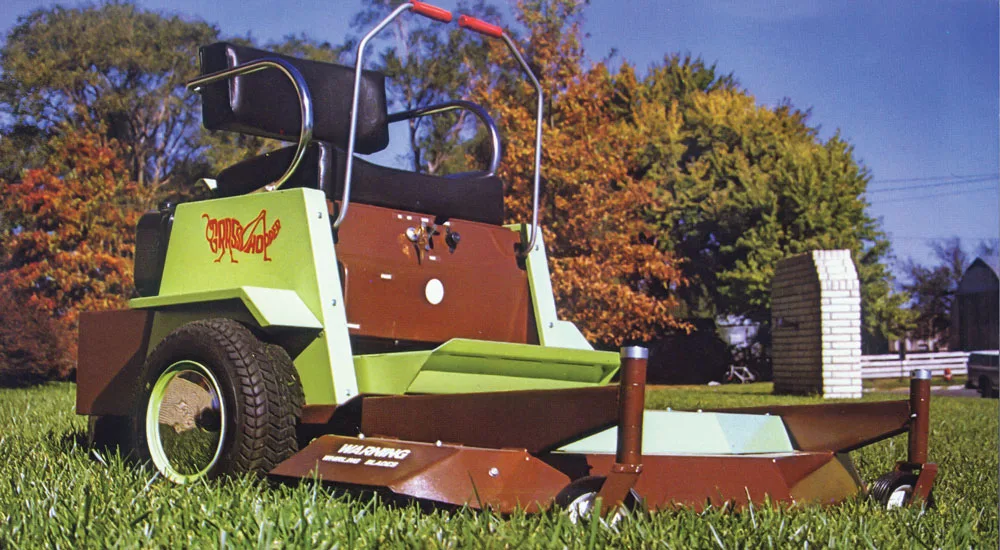
Grasshopper’s parent company, Moridge Manufacturing, Inc. was founded in 1958 by Stan’s parents, Elbert and Marvel Guyer, and focused on producing portable grain dryers, spring-toothed harrows and other farm accessories. In 1969, after acquiring the original 1964 designs for the Grasshopper zero-turn mower, the Grasshopper Company was established as a division of Moridge. Zero-turn mowers were being developed by several different companies back then, Guyer says, but Grasshopper was the first that consistently worked to become a market-ready product.
When describing his role in the company, Guyer illustrated he was no stranger to the business from an early age.
“I was born in Osborne County [Kansas], and I had a factory and a farm as a playground,” he says. “I was helping with silkscreens at about eight or nine, which fascinated me.”
Guyer says he was operating heavy machinery like Cincinnati planers from the age of 8 and even helped build a 12-stage progressive die at the same age.
“My brother and I would have contests and see how many clips we could make for the milo guards on an OBI press that had absolutely no safeties. I was involved as a child early on, and I worked in the company all through school,” he says.
Guyer’s official start at Moridge was in 1965, and he soon became plant manager.
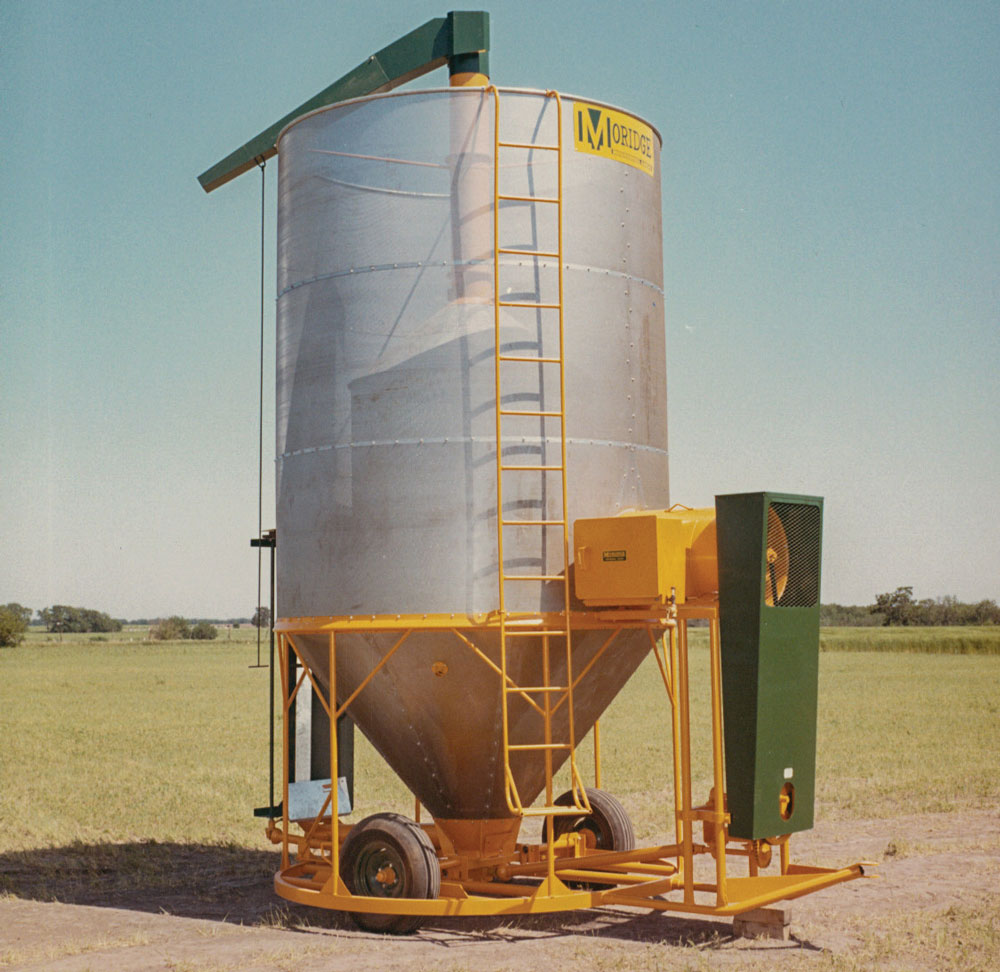
A Moridge Portable Grain Dryer, the product that put Moridge Manufacturing Inc. on the map in the late 1950s and early 1960s. Grasshopper
He served in the National Guard and was sent to Fort Carson, Colo., in 1968. Once he was released from service, he returned to Moridge to oversee all facets of manufacturing.
When asked what lessons Stan learned from his father after years of working alongside him, Stan recalled a phrase his father often used.
“His favorite saying was ‘you can’t sell from an empty wagon.’ In other words, you better have the product ready to go.
“You’ve got to have the product, but sometimes you can’t even give it away — and then all of a sudden everybody wants it. That happened especially with the grain dryers.”
From Grain Dryers to Lawnmowers
The change to production of lawnmowers was a gradual one, Guyer says, and was an opportunity that arose out of a difficult time.
“We had several products we were developing through the years, and some of them had legal hurdles. Manufacturing is high risk; one incorrect or incomplete patent filing, and you can be out of business.
“In January of 1980, [President] Jimmy Carter threw an embargo on grain going into Russia. We lost three carloads of orders within one day. In 48 hours we had zero orders for any grain dryers, and that gets your attention.”
The Russian grain embargo caused Moridge to reconsider its business model, and that was when the Grasshopper mowers became vital to keeping the company afloat.
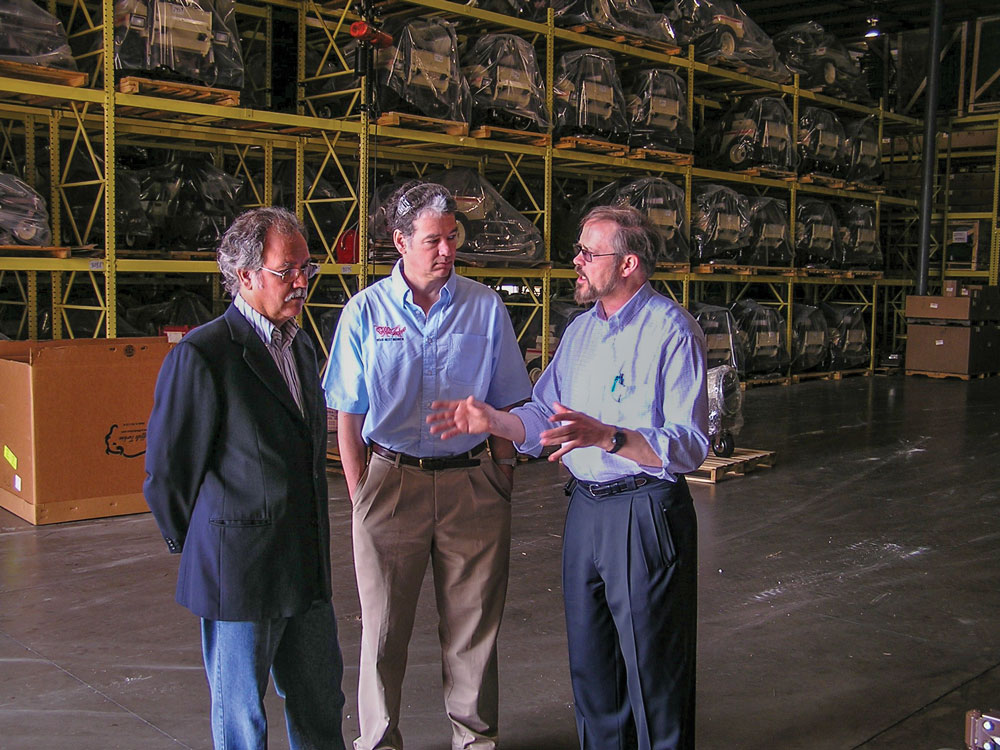
Stan Guyer provides a Grasshopper factory tour to international visitors. Grasshopper
“Again we learned manufacturing is a high-risk business, and that was one of the most severe tests we faced. I think we had a 10% layoff, and then optimized the labor we retained and went on producing other products.”
One of these other products was the Grasshopper zero-turn mower. Guyer stated that the zero-turn lever steer mower was invented in Moundridge, and the Grasshopper model took off from that. He recalls a gradual yet large shift in the business as they transitioned from grain dryers to lawnmower production.
“For example, one time we were running some of the mowers, and producing them in small quantities, when a foreman came up to me and asked what we were doing. I said, ‘We have to get these done; we have orders for them.’ And he replied, ‘Well, we’re a grain dryer company. We don’t make lawnmowers.’ I recall replying something to the effect that someday we may really appreciate them, and ultimately we did.”
Finding a Place in the Market
Response to the zero-turn Grasshopper mower was originally met with surprise from the market, but the farm community was receptive. “The farm market was our biggest customer base originally because you didn’t have to explain the concept of a zero-turn mower to a farmer. He understood it.”
Guyer says Grasshopper has had a steady growth in residential and contracting customers, but that didn’t come without periods of challenge.
“There are always cyclical ups and downs. For example, the 2008 market downturn was not a pleasant time; there are rebounds, but you have to find a way through the trough,” says Guyer. “But we have loyal customers who stick with us year after year. We are a charter member of the National Farm Machinery Show, and every year for the past 60 years, there are many people that tell us they have owned 5 or more Grasshopper mowers, or that they are still running their first one that is 25 years old.”
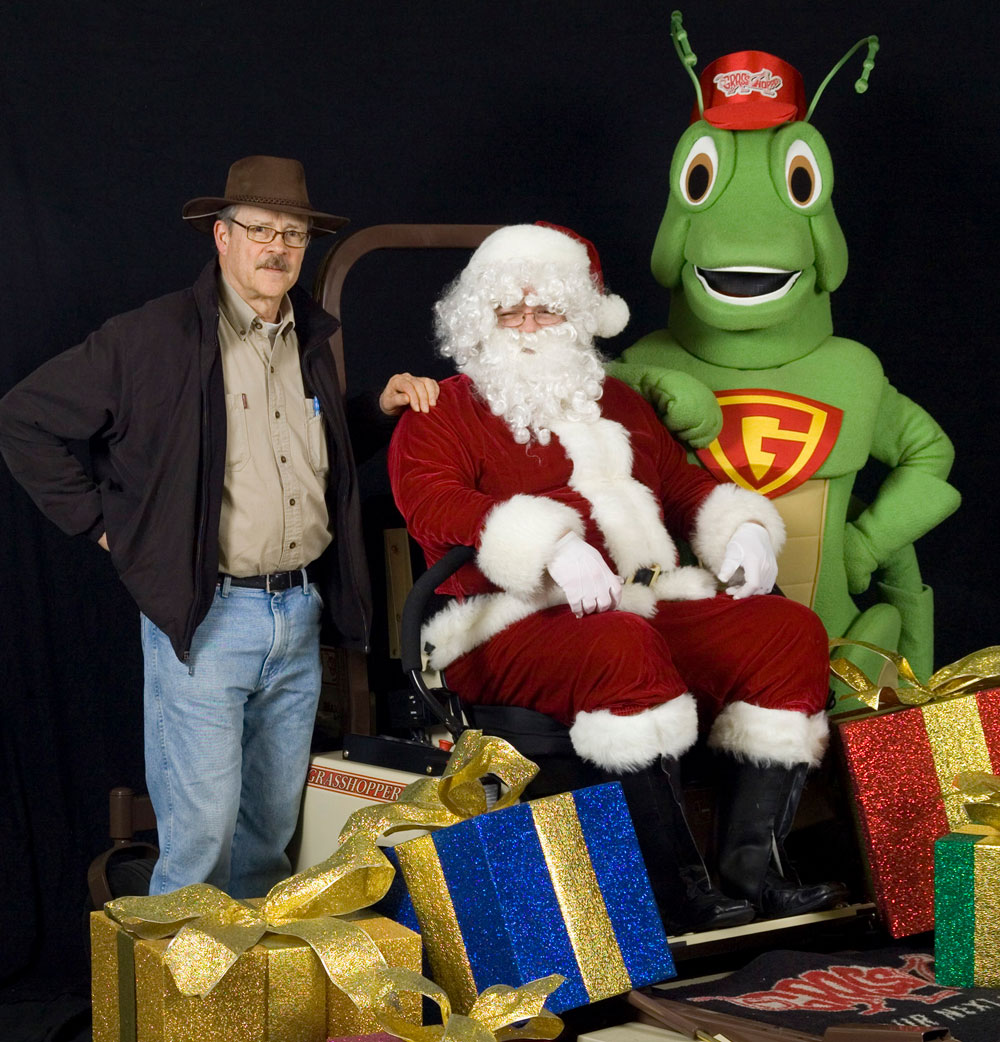
Stan with company mascot G-man and a visit from Santa Claus during a Christmas Kids event. Grasshopper
“We’ve been in manufacturing for quite a while. We’ve developed a lot of successful products, and some that weren’t so successful. All the while, it’s important to maintain that customer loyalty. And that’s where the family aspect comes in. When I work a show, I am always asking our customers questions such as how it’s working for them and how we can improve. It takes a personal approach like that.
“That’s why we have a live operator who answers calls at our factory. Nothing is more frustrating than to call a company and have to go through a litany of prompts. We could automate that, but it would come at the cost of the personal touch that many of our customers appreciate.”
When asked what he was most proud of in regard to his company, Guyer says it’s the product and its family run history.
“The thing we’re most proud of is the fact that we are more concerned about the long-term performance of the products we make than in short-term results,” says Guyer. “A large corporation is always worried about the next quarter. As a family, we’re not just thinking about the next quarter, but the next year, and the year after, and so on. We make decisions collectively based on the long game, not the short one.
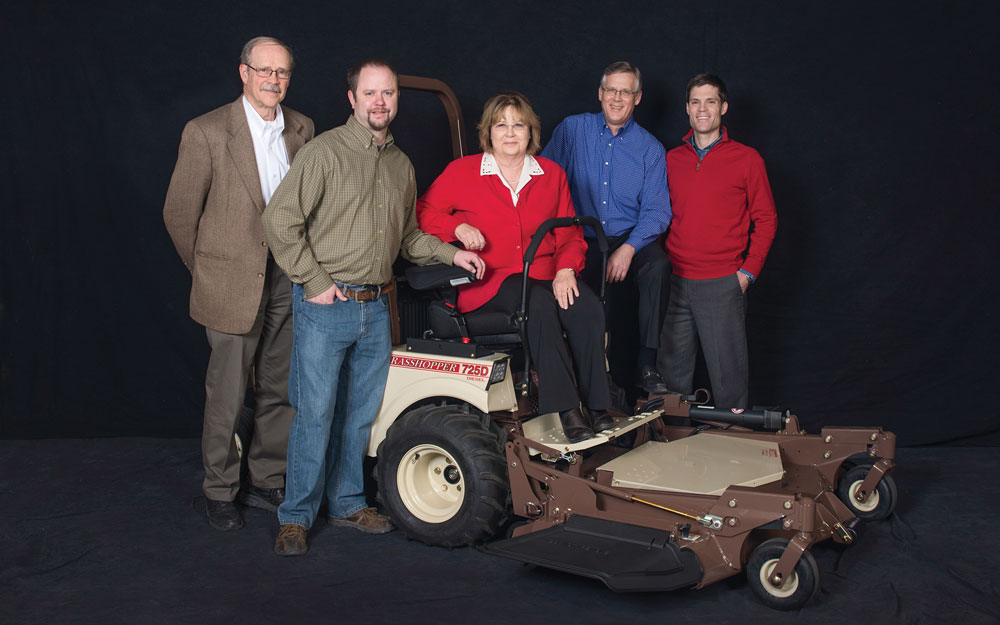
The Grasshopper company board is a mix of second- and third-generation members. This photo includes Stan Guyer, Nathan Guyer, Ruthanne Stucky, Duane Guyer and Trent Guyer. Ruthanne passed away earlier this year. Grasshopper
“We’re also proud of how we approach communication with our customers and vendors, and we’re respected in the industry for that.”
When describing how Grasshopper stands out from the competition, Guyer points to the performance of Grasshopper products.
“Probably the most important thing we do is that we use a design-match approach to our products,” he says. “It may not run quite as fast as a competitor’s, but it’s better balanced to get the best performance out of that machine. We make machines that are extremely easy to operate. We are more interested in putting out a good product rather than meeting a deadline or being the ‘first’ to do something.”
Managing a Family Business
Grasshopper is still a family business, with a mixture of second- and third-generation leadership, including Stan and his son, as well as Stan’s brother and his brother’s son and daughter.
“My son started quite young, and he worked in the parts department. I told him never to say that he is the boss’s son,” Guyer says. “If something’s to be done, you do it twice as good as anybody else. They all had to learn to earn respect and responsibility, not assume it was due because they are family.”
Guyer acknowledges that running a family business comes with unique challenges.
“Most family-owned companies don’t last beyond the third generation,” he says. “But our next generation understands both the responsibility and the opportunity that comes with carrying this business forward. They respect what previous generations built, they understand the challenges ahead, and they are committed to preserving that legacy while continuing to strengthen the company for the future.”
Regarding the future of Grasshopper, Guyer mentions continuing to reinforce the company’s commitment to its existing customer base, as well as growing previously underdeveloped markets and expanding the company’s international footprint.
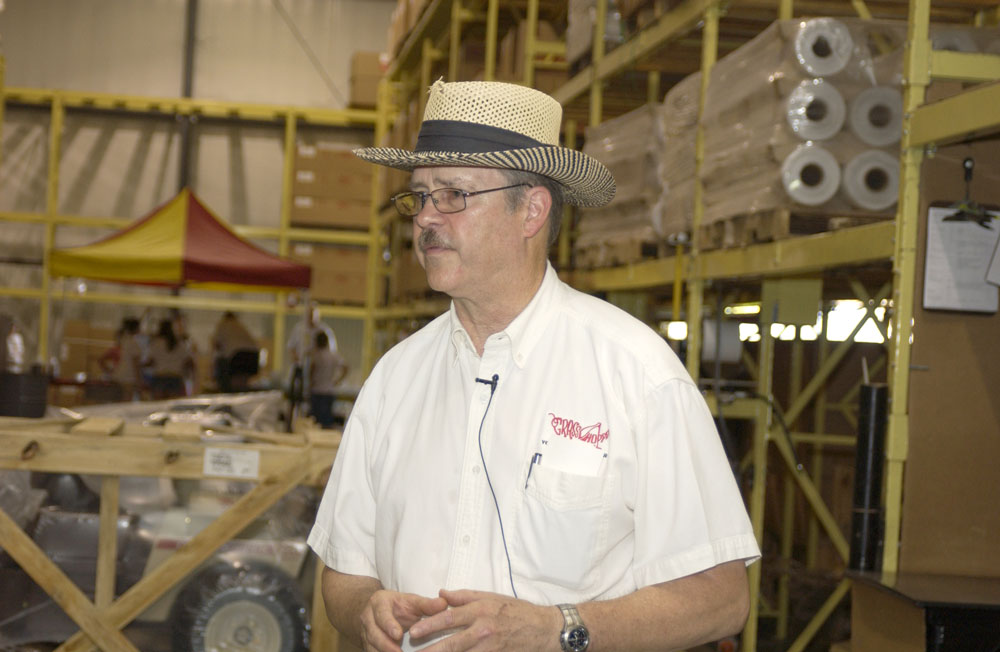
Stan Guyer at a factory tour showcasing the Grasshopper manufacturing process. Nearly every stage of production to make a Grasshopper mower occurs in the same building. Grasshopper
“We continue to focus on our bread-and-butter, the original ride-on zero-turn mowers we are known for,” he says. “And, we recently released a new line of stand-on mowers to build up the commercial contractor customers. We are expanding our global distribution, because there are many markets worldwide that have little to no awareness of zero-turn mowers, so those are areas that have great potential for growth and success.”
In response to growing competition, Guyer is confident in the quality of the Grasshopper product.
“We are holding our own. We offer more than 70 different models, and each one is a commercial-grade product,” he says. “We produce front-mount, mid-mount, and stand-on mowers, and offer implements and attachments that can transform these mowers into snowthrowers, blowers or brooms for year-round productivity.”
“Most of our competitors are focused on lower-end, non-commercial-grade products,” he says. “But, we have a full line to offer to anyone looking for a commercial piece of equipment.”
When asked what sets Grasshopper apart, Guyer says it is the experience of operating one.
“If you really want to understand what we do, go get on a Grasshopper and demo it,” he says. “A lot of people think a zero-turn is a zero-turn is a zero-turn, but it is far from that. It’s a difference you can feel the first time you get on our machine.”