Takeaways
- Unconventional ideas often face initial skepticism before proving their value.
- Initial negative feedback toward new products or changes should be discussed rather than dismissed.
- Be willing to think outside the box and see the possibility a new idea can bring.
Around the turn of the century, in the early 1900's, a Midwest farmer and entrepreneur, Ummo Luebben, invented a hay baler using flat belts that made round hay bales. This was a "fitting a round peg in a square hole" type of puzzle that he solved.
Every farmer back then knew hay was stored loose in a loft or baled in square bales. The loft in an old barn on our farm actually had loose hay pulled out, baled into squares with a stationary baler and then put back in the loft. Go figure.
The Luebben baler drew the attention of Harry Merrit, marketing manager of Allis-Chalmers. Harry was the man who had the courage to change the Allis-Chalmers tractor color from green to orange; he was not afraid of change.
He had the company's lawyers purchase the rights and patents to Luebben's baler and get to work on making the crude baler have a little sex appeal as we say, when assembled and displayed on a dealer's lot.
Can we as dealers appreciate the challenge of this new product that was radically different from the industry norms? Can you imagine the dealer's response when a round baler was first introduced?
Bales of hay are square, period, right ? Harry said no. (Reminds me of the old joke of the farmer sending his son to college then parading him in front of the old farmers at the feed store sitting around the potbelly stove. "Say something in college-talk son!" The boy proudly states: 'Pi-R-Square'. The dad replied, "Oh my son, I spent all that money and you come back saying this? Everyone knows Pie R Round, Cornbread R square!")
I am sure some dealers mocked the new product while others went on to sell tens of thousands of the units to farmers across the U.S. and Canada. My dad was the proud owner of a Roto-Baler and custom baled across the county. He was also the mechanic for the local dealer on these units and handled the field service calls. In proof, I know what a soft center brake attachment is, to any old hands out there.
Back to the point of all this, however. How do we handle change and new products? Our company introduced a 3-cylinder 100-hp tractor. I had a come apart. Who would buy a 3-cylinder 100-hp tractor?
I was wrong. We have sold nearly 100 of these units with little to no complaints or objections. I almost blew an opportunity by thinking all bales are square.
Back to these balers. The rumor going around the old Allis company was that one of the engineers working on the Roto-Baler approached his boss and made the pitch of making the baler even larger. Let's make a 4-foot-by-5-foot version.
He was laughed out of the office.
First, the bale would weigh so much it could not be picked up and was not be able to be fed properly and second, the baler would cost so much no one would be able to afford it.
Later, the Vermeer Brothers took the project on and, well, the rest is history.
The company that invented the round baler couldn't take the next step due to not thinking of the possibility and opportunity vs. the norm.
We all need to keep these stories in mind when making our decisions. Sometimes initial inclinations need to be studied before the knee-jerk reaction is made final. I am noticing that a lot of new products are being promoted mostly by young folks... that says something as well, eh?
Til next time, remember, round pegs can sometimes fit in square holes — with a little effort.
|
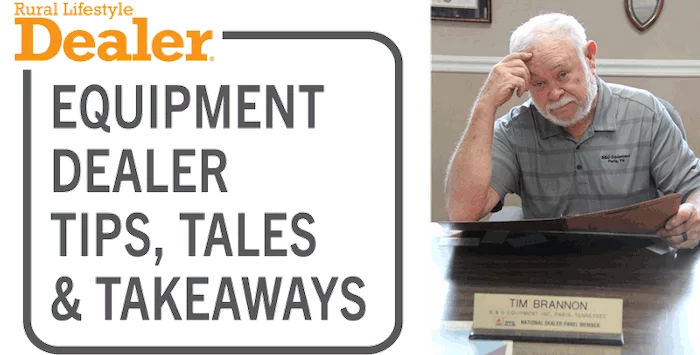
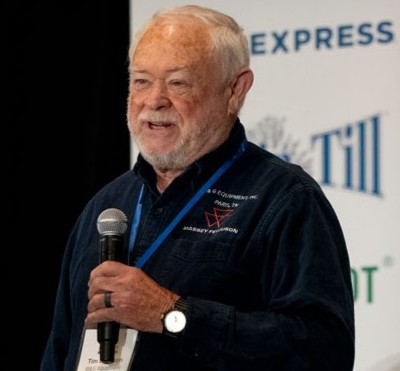
Told from the perspective of an in-the-trenches owner/operator — Tim Brannon of B&G Equipment, Paris, Tenn. — Equipment Dealer Tips, Tales & Takeaways shares knowledge, experiences and tips/lessons with fellow rural equipment dealerships throughout North America. Covering all aspects required of an equipment dealership general manager, Brannon will inform, entertain and provide a teachable moment for current — and future — leaders within equipment dealerships. |
 |