An ag tractor dealer started by Homer More in 1913 is still running strong, led by the 4th generation leader of the family. At the helm today is Andy More, president, Homer’s great grandson. While he has officially been with the dealership for 30 years, he started coming into the original shop as a boy. Andy’s son Joey, now representing the 5th generation, works with the dealership on the marketing side, and Andy’s grade school age nephew, has already expressed interest in working there, even having visited to watch and help the service techs over this past summer.
“I’ve been here my entire life. I came every day from the time I was in kindergarten on, but I’ve been here full time since 1996 when I graduated from college,” explains More. “We only had a single location from the time I was first coming here. In 12 years since I became president in 2013, we’ve gone from 1 to 5 locations. I don’t know if that’s smart. I don’t know that the decisions that we’ve made and the growth are always the right ones, but we do the calculated risk of working to research it, go through and see what’s happened in the past, what history tells us and then make a calculated decision. So far, we’ve had luck with those although not all of them have been right.”
Takeaways
- Reviewing market share and sales history, leveraging manufacturer terms and stocking what is good for the dealership and its customers combine for strong inventory management strategies.
- Establishing policies and procedures enhances communication, allows team members to better adapt to changes while supporting operational efficiencies amidst dealership expansion.
- Having staff to focus on operations and develop a change diagram provides insight into whether a dealer has the right tools and the right people to follow through on decisions and strategies.
More Farm Stores sells primarily Kubota, Toro, Land Pride, Stihl and Bad Boy mowers. More says close to 70% of the business is commercial contractors, with the other 30-40% homeowners (or Home Owners with Acreage, HOWAs), along with commercial and municipal business customers. It opened the 5th location earlier this year and presently has a total of 50 employees.
Maximizing Operations While Adding Locations
With the main store located in Columbia City, Ind., other locations include Warsaw (20 miles to the west), Fort Wayne (30 miles to the east) and the fourth store is in Kokomo, Ind. (85 miles from the main store). More says this creates enough separation that they are not overlapping. The store More most recently acquired to the east is in Ridgeville Corners-Napoleon, Ohio, in January 2025. More says they are in a bit of a transition because of the 5 locations.
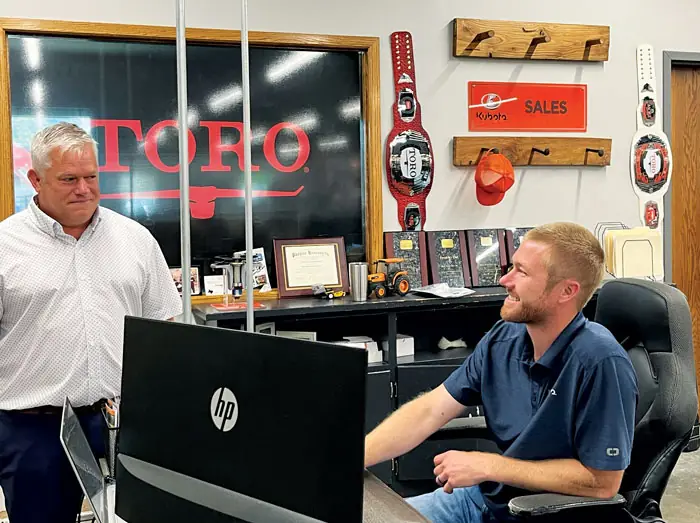
“At one location or even 2, it’s easy to have your hands in everything and be involved in every transaction. At 5, it’s more difficult, he says “You spend all your time on the road and on the phone. “I just hired an operations manager for the first time ever. For me to let go of the reins a little bit, it’s scary. But the gentleman we hired is a school superintendent with a doctorate in education, very highly educated. He’s exactly my polar opposite — detailed, scheduled, diligent, he follows through, follows up, which I don’t. I’m relational. It’s been really healthy there.”
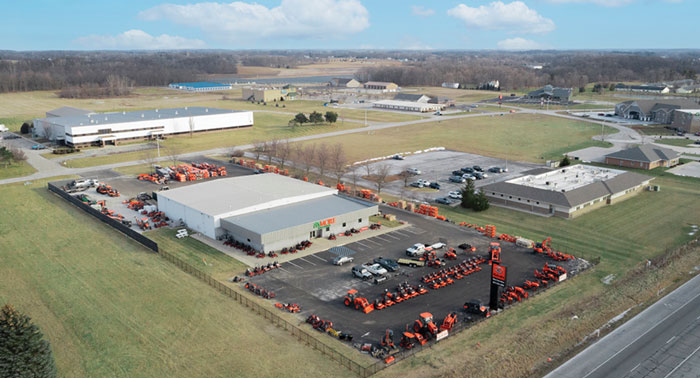
This More Farm Stores dealership in Columbia City, Ind., serves as the main location, with 4 others added in the past 12 years, the newest having opened in Ridgeville Corners-Napoleon, Ohio in January 2025. Source: More Farm Store, Inc.
More has all of the managers in the Columbia City location, each with a salesman, sales assistant, parts person, service desk person and 2 technicians. He also has 3 people in the administrative office, a controller with 2 assistants, 8 sales team members, 3 in rental with the remainder of the staff focusing on service.
When asked what his top pride points were, he says the 5th generation, with his son now working with him, is a top one.
“The other thing we focus on, and I think we do right, is that our goal is to be the most honest, most trusted dealer that Kubota, Toro, Bad Boy and Stihl have. I think our guys do a really nice job of that.”
Training Techs
When it comes to recruiting new technicians, working to retain them and paying them well, More focuses on quality and resourcefulness. Combining top level training, being purposeful in providing high-quality working conditions and ensuring the techs are paid well are critical components to More Farm Stores’ ability to find, support and retain their service teams.
“I want to run this place like my grandpa and my pastor are sitting in the corner…”
“We try to utilize Kubota University for our tech training which has been really good for us, and we also utilize a lot of NAEDA training paths as well as NCM Associates, which is the Spader group. Those three places have been phenomenal for our training,” More explains. “I think just offering an attractive place to work is key. We have air-conditioned shops now and that makes a big difference on keeping guys. Paying appropriately, which also means charging appropriately is a big, big part of that. We’ve had really good luck on retaining the guys we want to retain.”
He adds that some of the technicians have been with the dealership 15-20+ years, and several are A level technicians who’ve come from different ag shops. More also acknowledged that the ag economy being down has opened up those resources quite a bit.
Dealer Realities & Strategies Post-COVID
Now that they are coming off what he calls the “COVID hangover,” More says everything’s hard again.
“We’re relearning the business, we’re relearning the new normals, trying to readjust to 2019 sales levels as far as units go. We’ve learned we have to work a lot harder than we did to make less money. What’s driving us is we have a really good dedication to providing an uncommon customer experience. Everybody says customer first, but not everybody does it.”
He explains that when they sit in meetings, their goal is to ask “Are we uncommon? Are we doing more than our peers, doing more than our competitors?” More says they spend a lot of time studying the industry and they spend a lot of time with NCM Associates, which he says has been fantastic.
The Outlook for OPE
“From the OPE side, I think we’re in a hard reset,” says More. “We’re in the middle of an inventory crunch, a lot of dealers are sitting on really heavy inventory, you’re seeing more discounting. That’s going to continue on, I think for the next couple of years. And then inventory should readjust and refill out. We’ve had to make some major changes to our stocking strategies, our inventory management, and so far it’s worked well. I think for the next 3 years it’s going to be steady business as usual, but tough business, very competitive.”
How does the dealership approach inventory management?
“Inventory management is an art and a science together. We have to look at our market share, we have to look at sales history, we have to look at market trends. Some of these manufacturers are offering extended terms, extended discounts. You have to leverage all of that together to make wise decisions. Also, one of the things that we’ve probably gotten better at more than anything else over this time is not giving into manufacturer pressure. We need to stock what’s good for More Farm Store, not what’s good for the manufacturer. We’re on a plan right now that I want 6 months of sales in the pipeline.”
Gaining Value from NAEDA, Update on Dealer Council
More’s family dealership has been a North American Equipment Dealer Assn. (NAEDA) member since before Andy More started there 30 years ago. As he presently serves on its OPE Dealer Council, he offers an update on priorities and progress in working with dealers and manufacturers for a stronger industry.
“A lot of dealers don’t really understand yet all of the value that being a part of an association brings in the outdoor power equipment world. In the ag world, dealers get it because ag has gone through some major shifts, the consolidation has been much bigger, a lot of things impact them more. All of those associations merging into NAEDA has brought strength in numbers, but also in resources. With NAEDA, I always look to them for advice on sales tax law, dock fees are getting to be a big one, trucking DOT laws, different things that affect us that we are not large enough to have an HR staff and an IT staff and a trucking staff.
“Being able to utilize them for those resources, both legal and technical advice has been huge. When they asked about doing it for outdoor power equipment, I was very interested just because those things are starting to trickle down into the Toro business and the Bad Boy business and contractual changes, etc. NAEDA just does a really nice job of defending the dealer and also educating the dealer, saying, ‘You may not like this change, but you have to understand that it’s good for the manufacturer, and your manufacturers have to stay in business in order for us to stay in business.’ We can get frustrated with our manufacturers, but we also have to step back and say, ‘More Farm Store wouldn’t exist without these manufacturers, so we need to make sure the manufacturer is healthy in order to be healthy with us.’ NAEDA does a great job of mediating those conversations.
“With the OPE council, its primary purpose has been, at least from my perspective, to first help the manufacturers like Toro, Briggs & Stratton, Stihl and other manufacturers to understand the value they bring to the table. I don’t think those manufacturers understood that. Now manufacturers like Toro are recognizing the power NAEDA has and the value that they bring to both sides of the table.
“NAEDA doesn’t exist just to defend the dealer from the manufacturer, they strengthen that relationship and help the manufacturers understand the perspective of the dealer, and in turn, they help the dealer understand the perspective of the manufacturer. That has been, in my opinion, the No. 1 goal. We’ve made a lot of progress with manufacturers. Not all of them have been excited about it, but I can specifically speak of Toro, having been involved there. Toro’s eyes have been open to what this brings and how this organization can help strengthen their dealer network.
“I’m also utilizing NCM Associates, which everyone knows as Spader and that leadership path, and I’ve got my operations manager doing the Dealer Institute, which is NAEDA’s path, and then we compare notes. They’re very similar, very good and they’ve each got their advantages, but it’s nice for us to have both paths and compare.”
During COVID, More says, the dealership had 12-15 months of inventory in the pipeline, but given the current market conditions 6 months makes more sense right now to keep the inventory fresh.
“Being a good dealer that’s honest, that works well with others is key,” he says. “Good dealer relations between dealerships really helps because inventory transfers are going to be important going forward.”
In terms of what’s working for the business, More focuses on policies, procedures and people.
“What’s working is sticking to policies, making policies that make sense, making policies that people understand. I now have an operations manager. One of the things he brought to the table was a change diagram.”
This was eye-opening to him. He explains that if they don’t hit every component of the change diagram, it makes it hard for people to understand what the change is and why it’s so important.
“Taking calculated risks in the next 3 years is what is going to make or break dealers…”
“To me it makes so much sense that everybody knows why we are making a change. What is this change going to do? How do we get there? Do we have the right people to make the change, the right tools? And are we following through?”
He says that with every change he tried to make for the 30 years prior that fell flat, he can look at that and think, “That’s why it didn’t work. It wasn’t that it was the wrong idea, it was the wrong implementation.
“Having the humility to hire people who can do things that you can’t is probably the biggest step to getting past the changes and challenges. Nobody’s good at everything, you just have to fill the seats with people who are good.”
When it comes to risk taking, More says it’s vital to measure whether it makes sense. “Taking calculated risks in the next 3 years is what is going to make or break dealers. I would advise myself and anyone else to make sure that if they are taking risks, they are very calculated. Risks are OK, we just have to know the upside and the downside, and really can we withstand that downside?”
When asked about his strengths, More reflects on the responsibility he feels running the dealership and maintaining high quality customer service.
5 Fast Facts About More Farm Stores
- Began in 1913 by Homer More, Andy’s great grandfather; later run by his grandfather, Gene, his father, Steve and uncle, Leon. Andy is the 4th generation and his son Joey, works in marketing and represents the 5th generation.
- The dealership maintained a single store until 2013, when Andy became president, and has expanded to a total of 5 dealerships (Columbia City, Fort Wayne, Warsaw, Kokomo, Ind., and Napoleon, Ohio).
- More Farm Stores has been a NAEDA member for 30+ years; Andy has been on the Board of the NAEDA OPE Dealer Council since its inception in 2022.
- Primary dealer of: Kubota, Toro, Land Pride, Stihl, Bad Boy mowers; and Land Pride, Landmaster, Walker, Legend, Griffin, and Construction Implements Depot.
- Key Achievements:
- Kubota National Dealer Advisory Board (Andy More)
- Kubota Elite Dealer (every year of the recognition program
- Toro President’s Elite Dealer (top dealer in Indiana)
- Toro Dealer Council 5 years (ending January, 2025)
- Land Pride Diamond Dealer
- Landmaster Platinum Dealer
Andy More is also actively involved in The Community Foundation of Whitley County, currently serving his 2nd 10-year term.
“I’m relational. I’m very customer focused. I care, I think some would say probably too much, but to me, we’re representing a product by putting our name on it. I tell a lot of people, especially our leaders, that I want to run this place like my grandpa and my pastor are sitting in the corner. If I have a strength, it’s just looking at those historical lessons I’ve learned from the past.”
When asked how he feels about the 112 year history of More Farm Stores, where it is now and where he sees it going and growing in the future, More was contemplative but confident.
“What does it look like going forward? I don’t know. As the mergers and acquisitions continue, I think it’s very hard for a dealer to stay the same size. You’re forced into growth — not everyone, but pretty much — just because of the competition coming in there. I hope to see it continue to grow. Right now it’s about continuing to try to build a company that has great value whether we decide to do something different or if we decide to turn it over to the next generation.
“The weight of history is heavy. Unfortunately, my father passed away last year. All of the prior family is gone, so the pressure of wanting to still do it right and thinking, ‘How would grandpa think of this decision, or great grandpa or my dad, those are very active thoughts every single day.’”